Fleet Management
Hidden Fleet Costs: 5 Money Leaks and How to Fix Them

Your trucks are running. Orders are coming in. Drivers are on the road every day. But at the end of the month, the profit is still lower than expected.
Sounds familiar?
Most transport business owners face this problem. The reason is usually not one big loss. It is many small losses that happen quietly every day. These are called hidden fleet costs, and they slowly eat into your profit without you noticing.
The good news is that once you know where the money is leaking, you can fix it and reduce fleet costs without cutting corners. In this blog, we will explain the 5 most common money leaks in a fleet business, how to spot them, and simple steps to stop them.
Hidden fleet costs are expenses that don't show up clearly in your daily reports. You pay for them, but you don't always see them.
For example, you know how much diesel you bought this month. But do you know how much of that diesel was wasted while trucks stood still with the engine on? Or how much was stolen?
That is the difference. Visible costs are easy to track. Hidden costs need proper tracking to find.
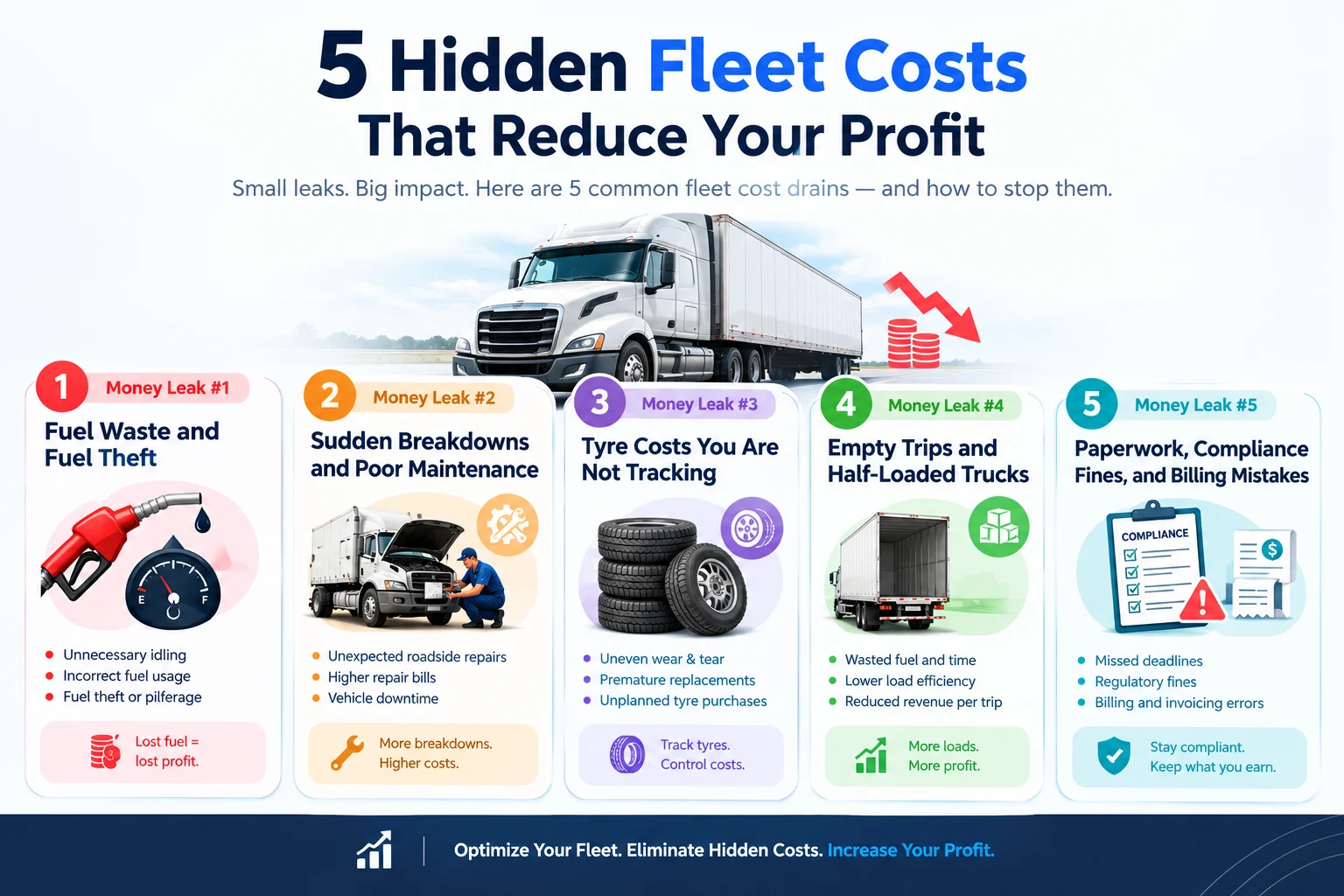
Below are the 5 most common money leaks in a transport business. For each one, you will see where the money goes, the warning signs to watch for, and simple steps to reduce fleet costs.
Fuel is usually the biggest running cost for any truck. That's why even small fuel waste turns into a big loss over time.
Where the money goes:
Engine idling: Trucks standing with the engine on during loading, unloading, or driver breaks.
Poor driving habits: Overspeeding, harsh braking, and sudden acceleration burn extra fuel.
Long or wrong routes: Extra kilometres mean extra diesel.
Fuel theft: Diesel being removed from the tank, or fake fuel bills.
A simple example: Suppose one truck idles for just 1 hour a day and burns about 2 litres of diesel in that hour. At around ₹90 per litre, that's ₹180 a day. Over 25 working days, that becomes ₹4,500 a month for one truck. If you have 20 trucks, you are losing about ₹90,000 every month, only from idling.
Warning signs:
Mileage is dropping, but trips are the same
Fuel bills don't match kilometres driven
Some drivers always use more fuel than others on the same route
How to fix it:
Use GPS tracking to see idle time and routes for every truck.
Compare fuel used with kilometres driven for each trip.
Monitor driver behaviour and reward drivers who drive efficiently.
Set alerts for sudden fuel drops in the tank.
Many transporters now use software that flags fuel theft and bad driving automatically. You can compare the options in our guide on the best fleet management software for Indian transporters.
Many fleet owners repair a truck only when it breaks down. This feels like saving money, but it actually costs much more.
Why breakdowns are expensive:
Emergency repairs on the highway cost more than planned servicing
The truck stops earning while it's in the garage
Delivery gets delayed, and the customer gets unhappy
Sometimes you have to hire another vehicle to complete the trip
A small problem like a worn brake pad or low engine oil, if ignored, can turn into a major repair bill.
Warning signs:
Trucks break down often in the middle of trips
No record of when each vehicle was last serviced
Repair bills keep going up every month
How to fix it:
Follow a fixed service schedule based on kilometres or days.
Keep a digital service record for every vehicle.
Set reminders so no service date is missed.
Track repair cost per vehicle to find trucks that cost more than they earn.
After fuel, tyres are one of the biggest running costs in a fleet. Yet most owners don't track them properly.
Where the money goes:
Tyres wearing out early because of wrong air pressure
No proper rotation of tyres
Poor quality retreading
Tyres getting swapped or stolen without any record
When you don't know how many kilometres each tyre has run, you can't tell whether you are getting good value or losing money.
Warning signs:
You buy new tyres more often than expected
No record of which tyre is fitted on which truck
Different tyre brands, but no idea which one lasts longer
How to fix it:
Give every tyre a serial number and record it.
Track fitting date, removal date, and kilometres run.
Check tyre pressure regularly.
Calculate tyre cost per kilometre to choose the best brands.
A smart fleet management system can track each tyre's full life, from fitting to retreading to replacement, so nothing is missed.
A truck that runs empty is spending money without earning any. This is one of the most common hidden fleet costs in India, especially on return trips.
Where the money goes:
Trucks returning empty after delivery
Trucks running half-loaded because loads weren't planned well
Vehicles standing idle in the yard for days without work
You still pay for the driver, the EMI, insurance, and fuel, even when the truck is not earning.
Warning signs:
Many return trips happen without any load
Some trucks earn far less than others every month
No clear view of which vehicle is free and where
How to fix it:
Plan return loads before the truck leaves for delivery.
Combine smaller shipments into one truck where possible.
Track the earning of each vehicle every month.
Use real-time tracking to know which truck is free and nearby.
If you handle smaller shipments, part truckload management software helps you combine multiple consignments and reduce empty space in your trucks.
This leak is often ignored because it doesn't look like a "fleet" problem. But manual paperwork costs transport businesses a lot of money.
Where the money goes:
Fines for expired documents like insurance, permits, fitness certificates, or PUC
Trucks detained at checkposts because of E-Way Bill issues
Billing mistakes and missed charges
Late payments because PODs (Proof of Delivery) are lost or delayed
Hours spent by staff on Excel sheets and phone calls
One expired permit can stop a truck for days. One missed bill can mean lost income that you never recover.
Warning signs:
You find out about document expiry only after a fine
Customer bills are often wrong or delayed
Your team spends too much time matching data from different sheets
How to fix it:
Keep all vehicle documents in one digital system with expiry alerts.
Automate E-Way Bill generation and tracking.
Use digital PODs so billing can start as soon as delivery is done.
Connect operations, billing, and accounting in one place.
This is where a smart billing management system helps. It connects your trips with billing and accounts, so bills go out faster, fewer charges are missed, and your team stops wasting time on manual work.
Managing all of this with registers, Excel sheets, and phone calls is very difficult, especially as your fleet grows. You simply can't watch every truck, every litre of diesel, and every document by hand.
A good fleet management system helps you:
See where every truck is in real time
Track fuel, idle time, and driver behaviour
Get reminders for servicing and document renewals
Track tyres and repair costs for each vehicle
Connect trips, billing, and accounts in one dashboard
In simple words, it turns hidden costs into visible numbers, so you can take action and reduce fleet costs before more money is lost.
If you are new to this, our simple guide on what is fleet management explains the basics step by step.
Hidden fleet costs don't feel big on a single day. But over a month or a year, they can take away a large part of your profit.
If you want to see all your trucks, fuel, maintenance, and billing in one place, try Logibrisk's transport management software. It is built for Indian transporters and helps you turn hidden costs into real savings.
Ready to stop the money leaks in your fleet? Book a free demo with Logibrisk today.
Hidden fleet costs are expenses that are not clearly visible in your daily reports, such as fuel wasted during idling, early tyre wear, empty return trips, and fines for expired documents.
For most transport businesses, fuel waste is the biggest hidden cost. This includes idling, poor driving habits, wrong routes, and fuel theft.
Start by tracking idle time and fuel use for each truck, following a regular maintenance schedule, and planning return loads in advance. These three steps alone can save a good amount of money.
Yes. Even owners with 5 to 10 trucks can lose a lot of money through small leaks. Software helps you track everything without hiring extra staff.
GPS tracking shows where your trucks are, how long they idle, and which routes they take. This helps you cut fuel waste, stop misuse of vehicles, and plan trips better.