Logistics Software
What is Route Optimization Software? A Guide for Indian Logistics Companies
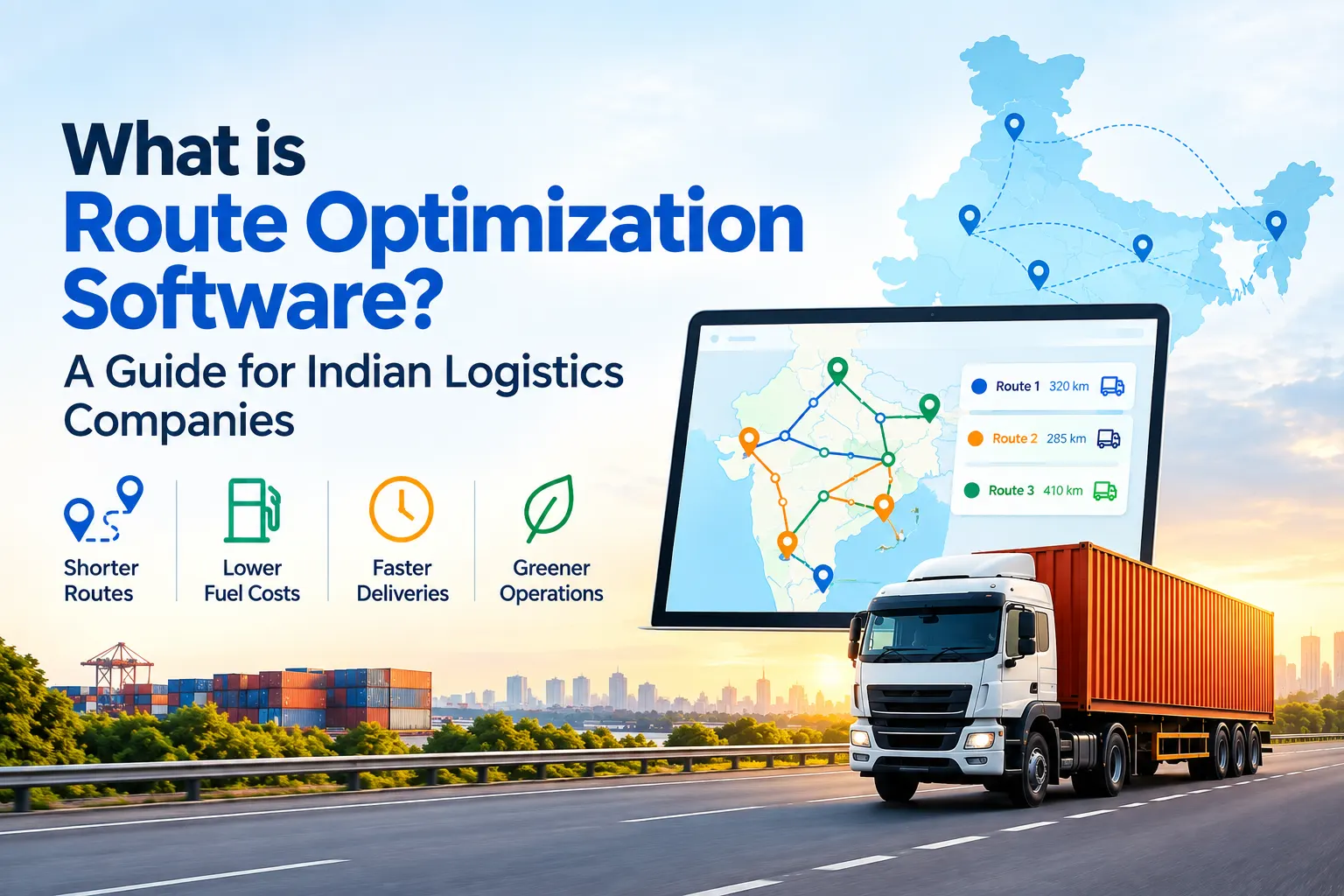
Every kilometre your truck travels costs money. Fuel, driver time, and vehicle wear all add up, and when routes are planned by hand, those kilometres are rarely as efficient as they could be.
Fuel makes up roughly 30% of total logistics costs in India. For every ₹10 lakh you spend running your fleet, about ₹3 lakh goes straight into the tank.
Poor route planning makes that worse. Drivers take longer roads, sit in traffic they could have avoided, backtrack between stops, and come back with half a trip completed. This guide explains what route optimization software does, how it works, and what to check before you buy.
Route optimization software uses AI, live GPS data, and routing algorithms to work out the best route for every vehicle in your fleet, automatically, in seconds.
It is not just a digital map. Route optimization in logistics means more than finding the shortest path between two points, which is all a standard GPS tool does. The software weighs up multiple stops, vehicle capacity, delivery windows, traffic, fuel cost, and road restrictions, then builds the best sequence for every truck at once.
You may also see this called route planning, vehicle routing, or route sequencing. They all describe the same job.
Once the system is set up, here is how route optimization works day to day:
| Factor | Manual Planning | Route Optimization Software |
|---|---|---|
| Planning time | 2 to 3 hours every morning | Seconds, for the whole fleet |
| Traffic data | Guesswork based on experience | Live and historical traffic feeds |
| When delays hit | Phone calls to each driver | Routes recalculate automatically |
| Fleet coverage | One vehicle at a time | Every vehicle at once |
| Load balancing | Uneven, depends on who plans | Stops spread evenly by capacity |
| Fuel cost | No visibility per route | Tracked and reported per trip |
| Proof of what happened | Driver's word | GPS log and timestamps |
Most operators reach route optimization as part of a wider system. Our guide to TMS software covers how routing, dispatch, and tracking work together in one platform.
The India route optimization software market was valued at USD 436.5 million in 2024 and is expected to reach USD 1,101 million by 2035. Indian companies are adopting it fast, and here is why:
Indian road freight has problems a global routing tool was never built for:
National highways keep improving, but state roads and last-mile stretches in Tier-2 and Tier-3 cities stay unpredictable. Good software factors in road quality and vehicle-type restrictions, not just distance.
Mumbai, Delhi, Bangalore, and Chennai have traffic patterns that shift by time of day and day of week. AI routing built on historical traffic data beats any manual estimate.
Different states mean different road networks, toll structures, and permit rules. Delays also put E-Way Bill validity at risk, since it runs on distance covered, which is why a GST and E-Way Bill enabled logistics system should sit alongside your routing.
Addresses are less standard, lanes are narrower, and GPS mapping is thinner. You need software that handles partial address matching and lets drivers confirm waypoints themselves.
Rural routes often have patchy coverage. Any app your drivers use must work offline, storing the route on the device and syncing once the signal returns. This is essential, not a nice extra.
Route optimization pays off fastest for these operations:
Not every platform is built for Indian conditions. Here is what actually matters:
Logibrisk builds route optimization software for Indian conditions, with support for Indian road networks, fleet workflows, and GST-compliant processes.
The platform plans routes, tracks vehicles live, and connects dispatch, delivery confirmation, and billing in one system, so a completed trip updates the invoice on its own.
Trusted by 500+ enterprises and used across 1 billion+ shipments, Logibrisk supports FTL, PTL, express cargo, last-mile, and 3PL operations.
Onboarding takes just 5 working days, and our team handles setup, GPS integration, and driver training.
Manual route planning made sense when fleets were small and volumes were manageable. In 2026, with fuel prices swinging and clients expecting more, it has become one of the most expensive habits a logistics company can keep.
Route optimization software does more than tidy up your routes. It hands you control of one of your largest cost lines and turns a daily headache into a process that improves with every trip.
The companies cutting costs and delivering faster right now are not doing it with bigger teams or newer trucks. They are doing it with better software.
Indian logistics companies still lose lakhs every month to fuel waste and late deliveries caused by poor planning. Book a Free Demo with Logibrisk and see what your routes are really costing you.
It is a platform that uses AI and live data to build the most efficient routes for delivery vehicles, weighing traffic, vehicle capacity, time windows, and fuel cost across a whole fleet.
It is used to plan daily delivery routes, assign stops across a fleet, track vehicles live, reroute around delays, and cut fuel spend. Most Indian operators start with fuel costs and delivery timing.
Logibrisk is a leading route optimization software in India, built for Indian road conditions and used by 500+ enterprises to cut fuel costs and improve delivery performance.
Yes. Good driver apps store the route offline on the device and sync automatically once signal returns, which is essential on Tier-2 and Tier-3 routes.
Fleets moving from manual to software-based planning typically report 15 to 30% fuel savings, depending on fleet size, delivery density, and how efficient their current routing is.
Most Logibrisk customers go live within 5 working days. The team handles setup, GPS integration, and training for dispatch staff and drivers.