Transportation Software
Top 7 Real-Time Shipment Tracking Benefits for Indian Transport Companies | LogiBrisk Blog
Ask any logistics manager in India what their biggest daily headache is, and the answer is almost always the same: I have no idea where my vehicles are until the driver calls me.
That single visibility gap between a truck leaving the yard and arriving at the customer is responsible for more delays, more disputes, more fuel waste, and more lost clients than most transport companies realise. Real-time shipment tracking eliminates this visibility gap by providing continuous updates on vehicle location, delivery progress, and estimated arrival times. And in 2026, with India's logistics industry valued at over USD 228 billion and growing at 7.7% CAGR, it is a gap that is becoming increasingly expensive to ignore.
Real-time shipment tracking closes that gap entirely. Businesses switching to real-time tracking are gaining complete fleet visibility, cutting fuel costs, and winning client renewals that manual operations consistently lose. This guide covers the top 7 business benefits it delivers for Indian transport companies and why the ones switching to it are pulling ahead of those still running on phone calls and guesswork.
Real-time shipment tracking is the continuous, live monitoring of a vehicle or consignment as it moves from pickup to delivery using GPS, IoT sensors, and mobile technology to provide location updates, ETA calculations, and delivery confirmations as they happen. Modern shipment tracking solutions go beyond just showing a dot on a map; they connect location data with dispatch, billing, customer notifications, and proof of delivery in one seamless flow.
Unlike manual tracking, where visibility depends on drivers calling in, dispatchers following up, and someone manually updating a spreadsheet, real-time tracking runs automatically. Every movement is recorded, every stop is logged, and every delivery is confirmed with a timestamp and GPS stamp, without anyone on your team making a single phone call.
India's logistics landscape is uniquely challenging. Road freight moves across 28 states with different infrastructure quality, toll structures, and traffic patterns. A truck leaving Surat for Delhi passes through four states, three major highways, and dozens of toll points, and without live tracking, the only way to know where it is at any given moment is to call the driver and hope he answers.
Customer service is now a core focus for most supply chain organisations. Tools that enhance customer satisfaction, including real-time tracking and flexible delivery, are considered critical investments. Indian transport companies using a modern fleet management system India businesses rely on can provide accurate shipment visibility, faster updates, and a better customer experience. Companies that cannot answer "Where is my shipment?" risk losing customers to providers that can.
Beyond customer expectations, the operational case is equally strong. Manual tracking creates information delays that cascade into decision delays. A vehicle that broke down three hours ago is still shown as "in transit" because no one updated the system. Real-time shipping tracking eliminates that lag, giving your operations team accurate, live information the moment anything changes on the road.
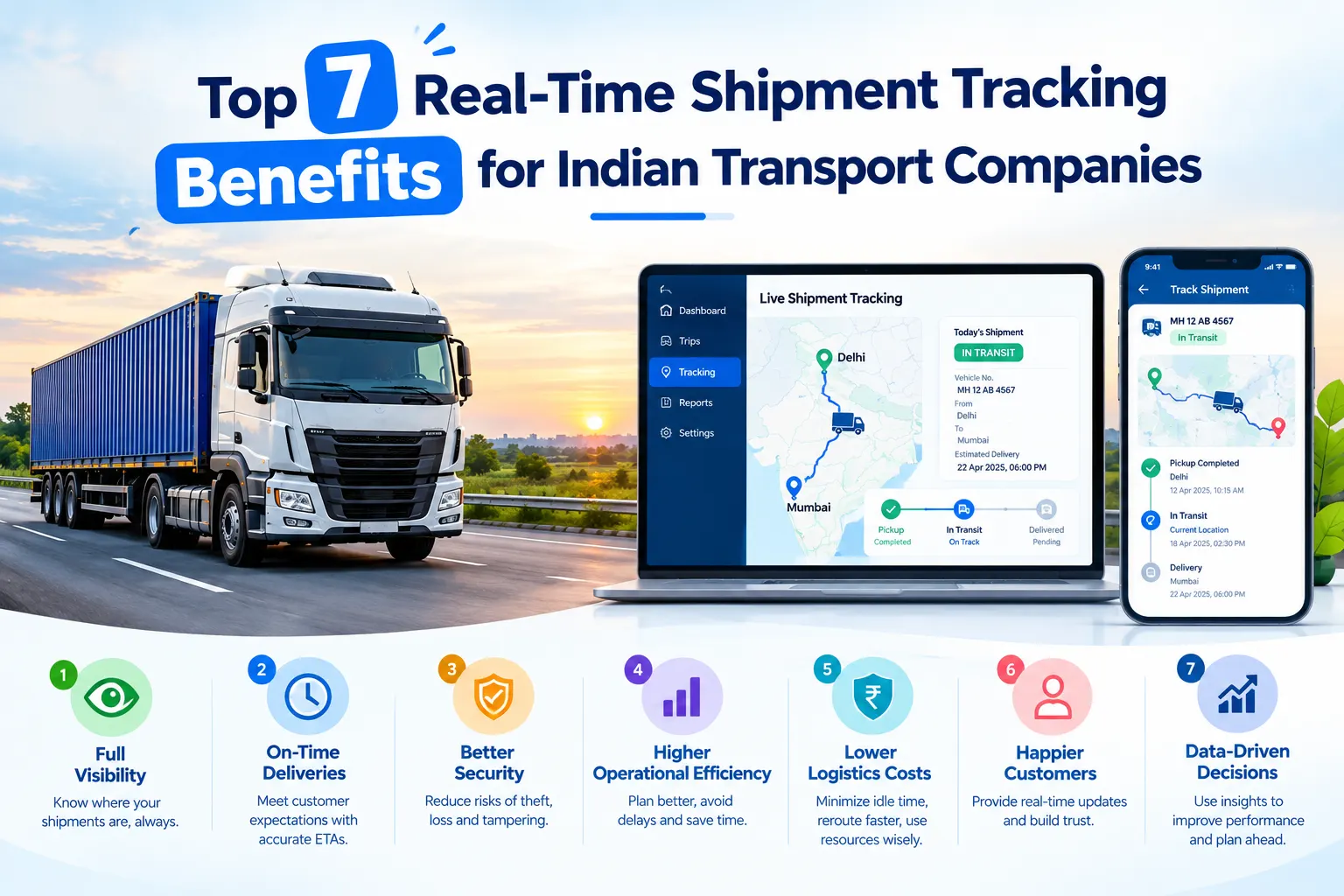
Real-time shipment tracking gives transport companies complete visibility into every vehicle, trip, and delivery. Operations teams can monitor live locations, route progress, and ETAs from a centralized dashboard.
Instead of relying on driver calls for updates, managers can identify delays, idle vehicles, and route deviations instantly, improving operational control across the fleet.
Live GPS tracking helps calculate delivery ETAs based on actual vehicle location and current traffic conditions. By integrating delivery solutions tracking, transport companies can provide customers with more reliable delivery timelines and real-time shipment visibility.
Accurate ETAs reduce missed deliveries, improve planning, and help businesses maintain consistent service levels even during peak demand periods.
GPS-stamped tracking records create a reliable audit trail for every shipment. Delivery status, location, and timestamps are recorded automatically throughout the journey.
When combined with digital POD software, businesses can quickly verify deliveries, capture customer confirmations, and resolve disputes using accurate tracking data.
Real-time tracking helps transport companies identify route deviations, excessive idling, and unplanned stops as they happen. This visibility enables fleet managers to take immediate action and reduce unnecessary fuel consumption.
When integrated with route optimization, tracking data helps businesses plan more efficient routes, improve fleet utilization, and lower overall transportation costs over time.
Real-time shipment tracking keeps customers informed with accurate delivery updates throughout the shipment journey. This reduces uncertainty and minimizes the need for status enquiry calls.
Customers who receive timely updates experience greater confidence in the service, leading to stronger relationships and higher customer retention.
Delivery confirmation is captured instantly through real-time tracking, eliminating delays caused by manual paperwork and paper-based POD collection.
When integrated with GST billing software, delivery data automatically triggers invoice generation, helping transport companies accelerate billing cycles, improve cash flow, and streamline payment collection.
Real-time tracking automatically captures data on delivery performance, route efficiency, driver behaviour, and fleet utilization. This provides a clear view of operational performance across the business.
With access to detailed analytics and reports, managers can identify improvement opportunities, optimize resources, and make informed decisions based on real operational data.
Real-time tracking delivers maximum value when it is integrated with a Transportation Management Software (TMS). Instead of functioning as a standalone GPS tool, a TMS connects tracking data with daily transport operations, creating a seamless flow of information across the entire shipment lifecycle.
Key ways a TMS enables real-time tracking include:
Centralised trip management: Every shipment, vehicle, driver, and route is managed from a single platform.
Live GPS tracking integration: Vehicle location updates are captured automatically and displayed on a real-time dashboard, enabling shipment tracking software to provide accurate visibility across every trip.
Driver mobile app connectivity: Routes, trip instructions, and delivery updates are synced directly with the driver's mobile application.
Automated customer notifications: Customers receive real-time shipment updates automatically, helping businesses using e-commerce delivery management software improve last-mile visibility and customer experience.
Instant delivery confirmation: Proof of Delivery (POD), signatures, photos, and timestamps are captured digitally and synced automatically.
Route deviation and delay alerts: Operations teams receive immediate notifications when vehicles deviate from planned routes or experience delays.
Integrated billing workflows: Once delivery is confirmed, invoices can be generated automatically, reducing billing turnaround time.
Performance analytics and reporting: Tracking data is converted into actionable insights on fleet utilisation, route efficiency, delivery performance, and operational costs.
Continuous route optimisation: Historical tracking data helps improve future route planning and reduce transportation costs over time.
Logibrisk's real-time tracking is fully integrated into its Transportation Management Software, connecting dispatch, route planning, billing, compliance, and delivery operations within a single platform.
Every vehicle, trip, and shipment can be monitored live through a centralized dashboard, giving operations teams complete visibility across transport operations.
The Logibrisk mobile app continues to work even in low-connectivity areas. Trip data is automatically synced once network coverage is restored, ensuring uninterrupted tracking and supporting more accurate planning through integrated Route Optimization Software.
Receive instant alerts for route deviations, delivery delays, and shipment confirmations, helping teams respond quickly to operational issues.
Every tracking event is stored automatically, creating a reliable audit trail for billing, proof of delivery, compliance, and dispute resolution.
With 1 Billion+ shipments completed and 500+ enterprises served, Logibrisk supports FTL, PTL, express cargo, last-mile delivery, and 3PL operations across India.
In 2026, real-time shipment tracking is not a premium feature reserved for large enterprises. It is the baseline expectation of every client who ships with you and the operational foundation every transport company needs to compete, scale, and retain business.
The seven benefits covered in this guide are not theoretical. They show up in fuel bills, billing cycles, dispute rates, client retention numbers, and the daily sanity of your operations team.
Indian transport companies are still losing clients, revenue, and operational hours to the visibility gap that real-time tracking eliminates overnight. Get a Free Consultation with Logibrisk and see live tracking across your entire fleet from day one.
GPS tracking uses satellite signals to determine a vehicle's location continuously. The location data is transmitted via a mobile network to a central platform, where it is displayed on a live map updated every few seconds, giving operations teams real-time visibility of every vehicle in their fleet.
Yes. Modern cloud-based tracking software scales to any fleet size. Even transport companies running 5 to 10 vehicles benefit significantly from the reduction in manual coordination, and dispute resolution alone quickly justifies the cost.
Modern GPS tracking is accurate to within 5 to 10 metres under open sky conditions. In urban areas with tall buildings, accuracy may be slightly reduced, but for all practical purposes, location data is precise enough to confirm delivery locations, detect route deviations, and provide accurate ETAs.
Yes. By alerting fleet managers to route deviations, excessive idling, and unplanned stops in real time, tracking software enables immediate intervention that reduces fuel waste. Over time, the historical data also improves route planning, further reducing fuel consumption per trip.