It's 7 PM. A client asks where his truck is, and you check WhatsApp, call the driver, then open a spreadsheet. Twenty minutes gone, for one question about one truck.
Nothing is wrong with your business. You have simply outgrown the tools you started with, and almost every transporter in India starts with the same ones: spreadsheets, Tally, WhatsApp, and the GST portal.
This guide explains what ERP software for logistics actually does and which benefits matter most. You will also see what to check before buying, and how to judge the return.
What is ERP Software for Logistics?
ERP stands for Enterprise Resource Planning. For a transport business, it simply means one system instead of six that don't talk to each other. Fleet, billing, accounts, GST compliance, client records, and reports all sit in one place, reading from the same live data.
Here is the practical difference. When a delivery is completed, the system does not just mark it delivered. In the same moment, it:
- Updates your vehicle records
- Triggers the invoice
- Updates the client's account
- Files the compliance record
Nobody re-types anything into a second tool.
People often ask how this differs from a TMS. TMS software for logistics handles your dispatch, routing, and vehicle tracking.
An ERP system handles all of that plus your billing, accounts, compliance, and client records in the same place. That is the practical dividing line between ERP software for logistics and a tool that covers one function.
For a transporter in Gujarat running Full Truck Load (FTL) trips into Maharashtra and Rajasthan, that means dispatch, billing, and GST run off one record instead of three.
Why Transporters Need ERP Software
The pressure to change rarely arrives all at once. It builds quietly, and then one month it becomes impossible to ignore.
Complexity grows faster than your fleet
- A 10-vehicle operation survives on spreadsheets. A 50-vehicle operation with multiple clients, rate cards, and states cannot.
- The workload does not double when your fleet doubles. It multiplies.
Clients expect what your competitors already give them
- Real-time tracking, accurate ETAs, and same-day invoices are no longer premium features.
- Your client is not being difficult. They are comparing you to a transporter who already runs these systems.
Compliance has stopped waiting for you
- GST filing, E-Way Bill generation, and invoice matching now happen in near real time.
- One mismatch between your billing sheet and your dispatch record is enough to trigger a flag.
Separate systems cost more than they appear to
- Delayed invoicing, unnoticed fuel leakage, and untracked vehicles look like three different problems.
- They are all the same problem: data sitting in places that never get compared.
Every year on the old setup makes the switch harder
- More vehicles, more clients, and more history mean more to move later.
- The transporters who wait usually end up doing the same change under more pressure.
Top Benefits of ERP Software for Logistics
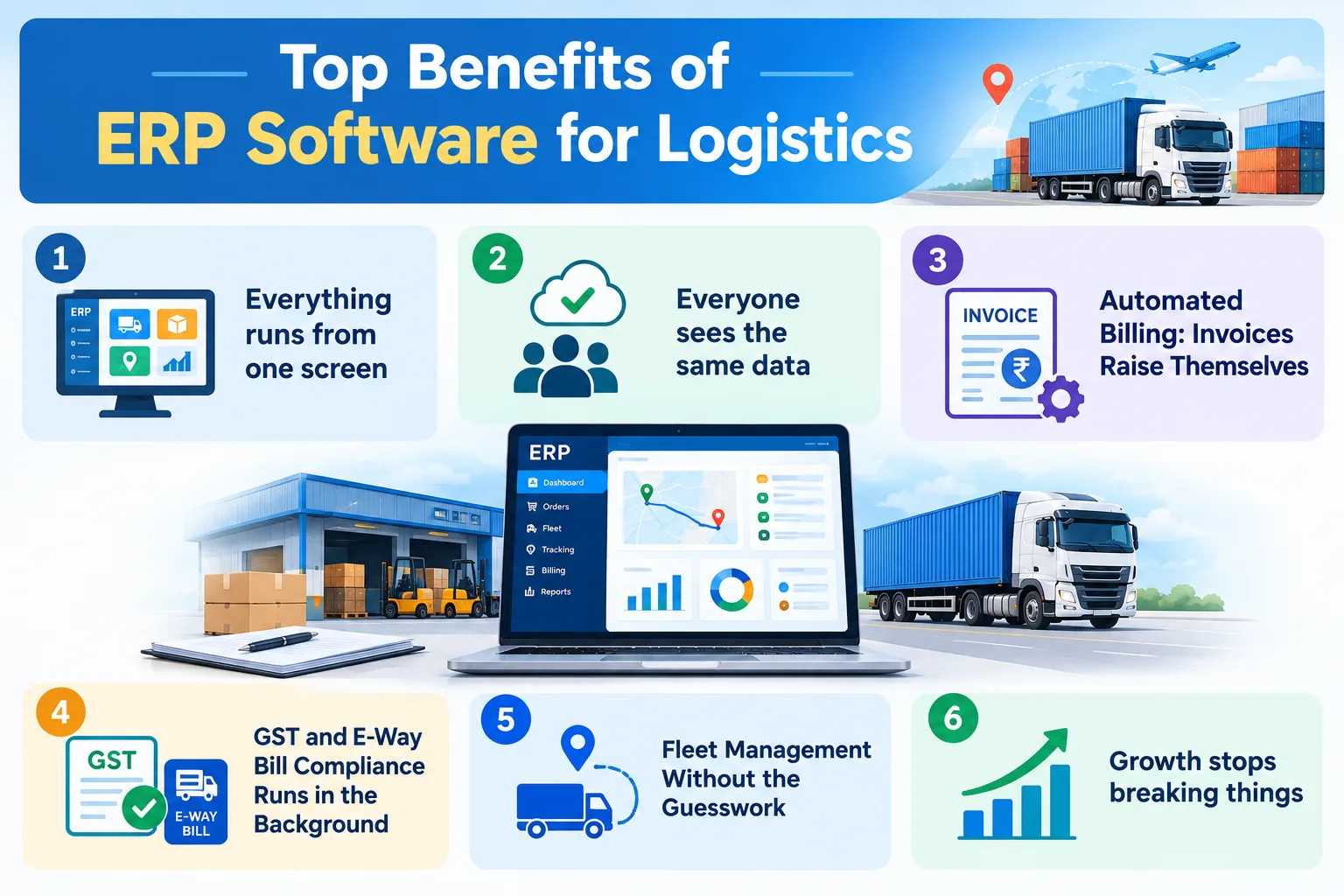
Everything runs from one screen
- No fleet tracking tool here, billing system there, and client list in Excel.
- A third-party logistics (3PL) company handling five clients with five rate cards can run dispatch, billing, and reporting from one dashboard.
Everyone sees the same data
- Operations, accounts, and customer service stop working from different versions of the truth.
- When a delivery is delayed, accounts sees the billing impact instantly and your team can call the client first.
Automated Billing: Invoices Raise Themselves
- Invoices generate automatically from confirmed deliveries, with the correct GST rate and HSN code already applied.
- For a company raising hundreds of invoices a month, smart billing management software removes the biggest cause of billing disputes.
GST and E-Way Bill Compliance Runs in the Background
- E-Way Bills, GST filings, and audit records are created as part of normal work.
- Nobody has to remember them on Friday evening, nothing waits for month-end, and nothing slips through.
Fleet Management Without the Guesswork
- Vehicle availability, driver schedules, maintenance status, and route data all live alongside dispatch and billing.
- With smart fleet management built in, you see which trucks are free during festive spikes instead of finding out when deliveries fail.
Growth stops breaking things
- A new client, service line, or city means switching on a module, not buying another tool.
- A fleet owner going from 20 to 100 vehicles does not need to rebuild everything at every milestone.
ERP vs Separate Tools: Key Differences Explained
How ERP Software Works in Daily Operations
Here is what one shipment looks like inside a connected system:
- A shipment is booked
- The ERP assigns a vehicle and driver based on real availability
- The route is planned and GPS tracking begins
- Delivery is confirmed digitally by the driver
- The invoice generates with GST and E-Way Bill data attached
- The client's account updates and the compliance record is stored
Five manual steps across three tools become one automatic flow.
Your team's day changes with it. Instead of pushing data between systems, they handle only the exceptions, like a delayed truck or a client query.
Key Features to Look for in Logistics ERP Software
Not every product sold as ERP software for logistics covers what a transport business actually runs on. Check for these before you commit:
- Fleet and GPS tracking: Live vehicle location, maintenance scheduling, and usage data, built in rather than bolted on
- Route planning: Smart routing that uses live traffic data to cut fuel costs and delivery times
- Billing and accounting: Automated invoicing, GST-compliant billing, and direct sync with the accounting management software you already use
- GST and E-Way Bill: Documents generated as part of dispatch, not through a separate portal login
- Client records: Client details, communication history, and agreed rates on the same platform as your operations
- Reports you can use: Live dashboards for fleet performance, billing status, and pending payments, with no manual compiling
- Driver app: A simple mobile app for trip updates and POD uploads, plus connections to your existing GPS hardware
Beyond the features, two things decide whether it works for you. Ask how long go-live takes, because a six-month project defeats the purpose. And test the support, because trucks move at night and on Sundays.
ERP Software ROI: Cost, Time and Revenue Impact
The return on ERP software for logistics shows up in three places, and all three are measurable.
Cost savings
- Automation cuts the hours your team spends matching sheets between systems.
- Fewer billing errors and no month-end matching is where most of the saving comes from, and it starts in the first few weeks.
Time savings
- Invoices that once took days now trigger the moment a delivery is confirmed.
- Compliance records stay ready to file, so month-end becomes a simple export instead of a scramble. We broke down exactly where those hours go in our guide to GST billing software for transport businesses.
Revenue impact
- Better vehicle usage means more deliveries from the same trucks, and faster billing means faster cash.
- Fewer disputes also mean fewer amounts you quietly give up on at the end of each quarter.
- To put that in context, Shree Azad Group runs over 500 branches across India on Logibrisk, managing FTL, PTL, fleet, and billing from one system.
Who Needs ERP Software in Logistics?
ERP software for logistics pays off fastest in these five situations:
- 3PL logistics providers juggling multiple clients with different billing structures, where matching everything by hand becomes impossible past a certain size
- Fleet owners running both full truckload and part truckload operations, where vehicle count has outgrown what a spreadsheet can track
- E-commerce logistics companies dealing with seasonal spikes, orders from several channels, and delivery windows that leave no room for manual coordination
- Express cargo and last-mile operators who need fast dispatch, live tracking, and accurate billing where an hour of delay matters, which our guide for courier firms covers in detail
- Growing transport businesses where separate tools have quietly become the main obstacle to taking on more work
For last-mile operations specifically, smart last mile delivery software handles route sequencing and COD settlement inside the same platform.
Why Indian Transporters Trust Logibrisk for Their ERP
Logibrisk is ERP software for logistics built in India, for Indian transport conditions. Everything sits in one place:
- Fleet management and GPS tracking
- Billing, accounts, and receivables
- GST and E-Way Bill compliance
- Client records and reporting
- Auction management for freight procurement and vendor payments
From vehicle assignment and route planning to invoice generation and compliance records, each step feeds the next automatically.
Nothing gets typed twice, and nothing gets forgotten.
As logistics ERP software built in India, for Indian conditions, the platform supports FTL, Part Truck Load (PTL), express cargo, last-mile, e-commerce, and 3PL operations.
Onboarding takes as little as 5 working days. Our team handles setup, integration, and staff training, so your trucks keep moving while you make the switch.
Is ERP Software Worth It for Your Transport Business?
The cost of running on separate tools never shows up on one invoice. It shows up in wrong bills, in GST notices, and in the work you say no to because your system cannot handle it.
An ERP takes that limit away. Your data updates on its own, so nothing has to be typed, checked, and fixed again.
See what changes when everything runs from one system. Book a Free Demo and find out where your hours are going.
FAQs
Q1: What is ERP software for logistics and transportation?
It is one platform that runs fleet, billing, accounting, compliance, and customer management together. Every department works from the same live data instead of separate files.
Q2: Which modules should a logistics ERP system include?
A logistics ERP system should cover dispatch, fleet and GPS tracking, billing, accounting, GST and E-Way Bill compliance, client records, and reporting. Anything missing becomes a spreadsheet again.
Q3: What are the benefits of using ERP software?
The main benefits are fewer billing errors, faster invoicing, automatic GST and E-Way Bill compliance, and better vehicle usage. Most transporters save the most time on data they no longer match by hand.
Q4: What are the four types of ERP?
The four types are on-premise, cloud-based, hybrid, and open-source ERP. Most Indian transport businesses choose cloud-based, because it needs no server and staff can log in from any branch.
Q5: How is ERP different from a TMS?
A TMS handles dispatch, routing, and fleet operations. An ERP covers all of that plus billing, accounting, compliance, client records, and reporting in one system.
Q6: Does ERP software help with GST compliance?
Yes. It automates GST calculations, E-Way Bill generation, and invoice management, so records stay filing-ready and the manual errors that trigger penalties drop sharply.
Q7: How quickly can I implement ERP software?
Most Logibrisk customers go live within 5 working days. The team handles setup, integration, and staff training, so operations keep running during the switch.