Logistics Software
Why Indian Transporters Need GST-Integrated Logistics Software
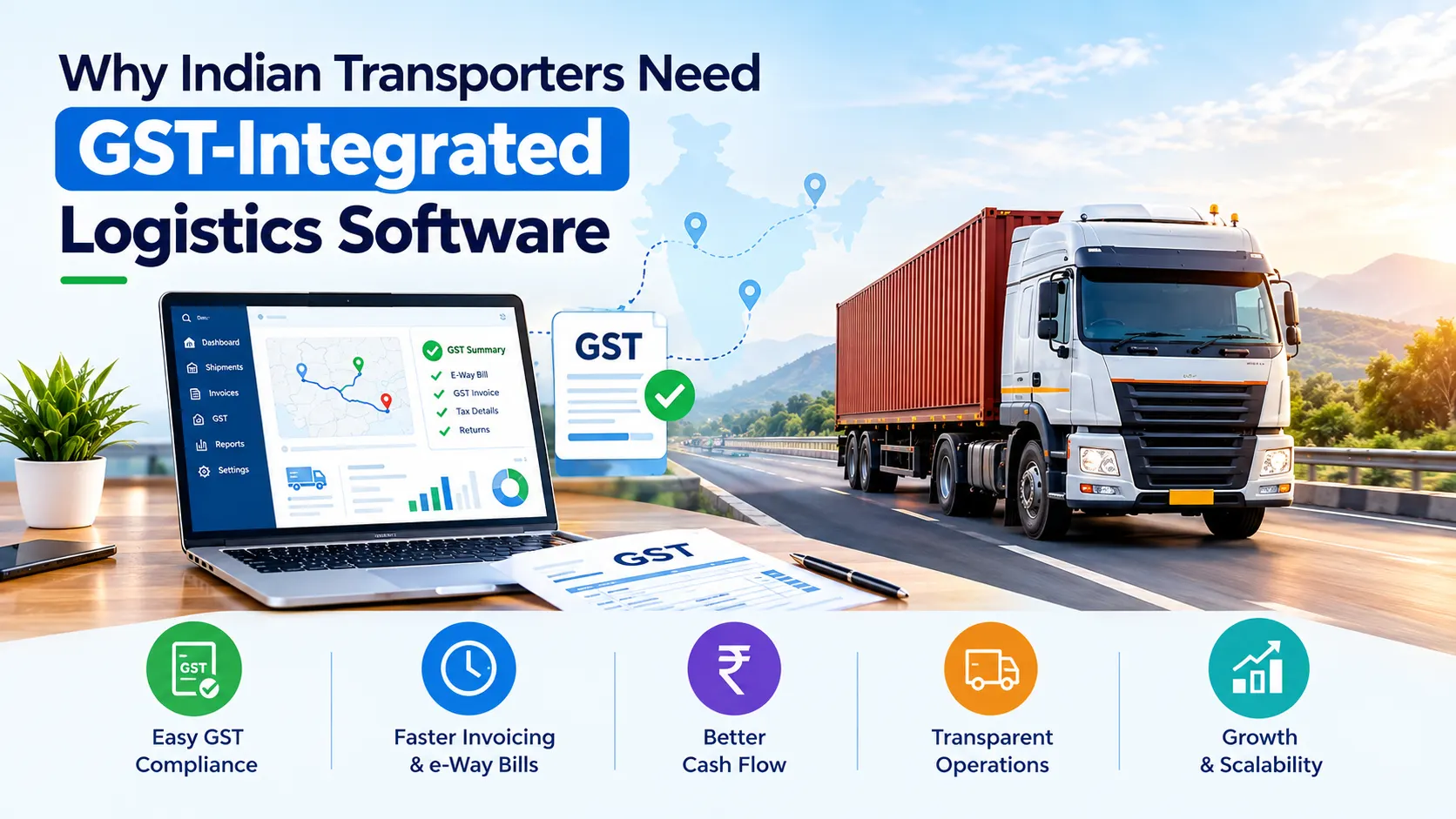
If you run a transport business in India, GST compliance is now at the centre of your daily operations. In 2026, it is stricter and less forgiving of manual mistakes than ever.
Every truck carrying goods worth more than ₹50,000 needs a valid E-Way Bill before it moves. Miss it, and you face vehicle detention, goods seizure, and a penalty of ₹10,000 or the tax evaded, whichever is higher.
Most transporters know the rules. The problem is the manual work, where one small typing error can stop a truck. That is why more transporters are switching to GST-integrated logistics software. This guide explains what it is, which problems it solves, and why it matters.
GST-integrated logistics software is a transport management platform with GST and E-Way Bill compliance built into the dispatch process. It handles document generation, expiry tracking, and audit records, so your team doesn't need to open the GST portal for routine shipments.
In a manual setup, dispatch creates a shipment. Then someone logs in to the GST portal, generates the E-Way Bill, and hands it to the driver. That is three steps, often three people, and three chances for an error.
With GST-integrated software, the E-Way Bill is generated as soon as the shipment is created. Part A is filled from the invoice, and Part B is filled when the vehicle is assigned. The driver gets the document before the truck moves, every time.
New to E-Way Bills? Read our complete guide on what is E-Way Bill in GST to understand the basics: who generates it, the validity rules, and the required documents.
The basic E-Way Bill rules are the same, but the portal now checks your data much more strictly before it lets a truck move:
180-day document rule: You cannot generate an E-Way Bill on an invoice or challan older than 180 days.
OTP Login: Every user must log in with an OTP sent to their registered mobile number.
Return-Based Blocking: Generation is blocked if GST returns are pending for two or more tax periods, or if a GSTIN is inactive.
Ship-To GSTIN: From 1 August 2026, the Ship-To GSTIN is mandatory in Bill-To / Ship-To transactions ("URP" for unregistered consignees).
Each of these checks can stop a truck if your team misses it. Good software catches them before dispatch.
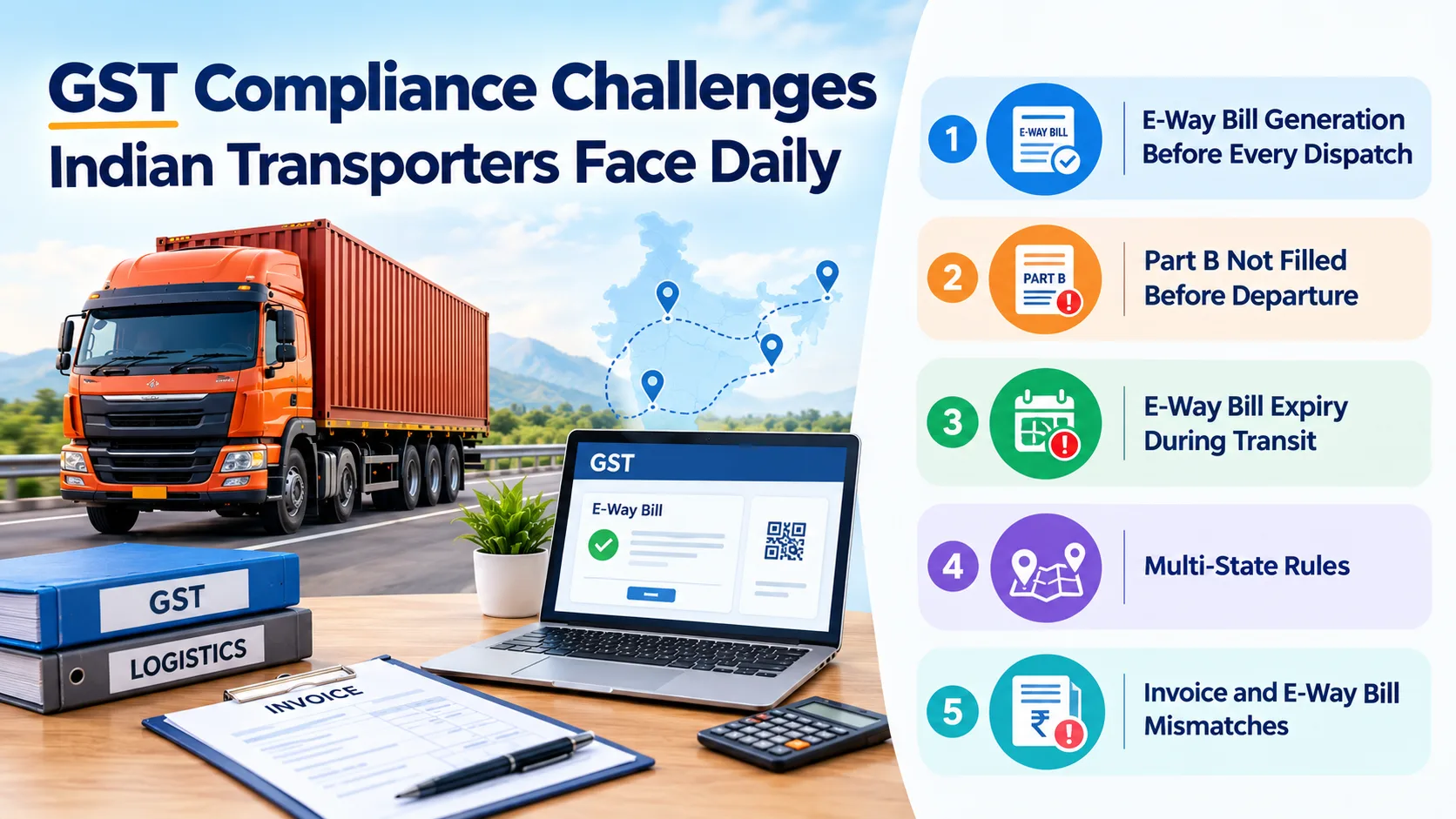
Beyond the new portal checks, these are the everyday problems of manual compliance.
Every consignment above ₹50,000 needs one. A transporter moving 50 trucks a day faces 50 portal entries and 50 chances for a mistake.
An E-Way Bill with only Part A is not valid for road movement. Accounts teams often generate Part A early, but the vehicle is assigned later. The truck then leaves with an invalid document.
For normal cargo, validity is 1 day for every 200 km. If a truck is delayed, the E-Way Bill must be extended from 8 hours before to 8 hours after expiry. Tracking this by hand for many trucks is nearly impossible.
Each state sets its own limit for movement within the state. A transporter working across Gujarat, Maharashtra, and Rajasthan has to track different rules for each.
A wrong invoice value or HSN code can cause compliance problems. GST systems now match documents against each other, so mismatches are much more likely to be flagged.
Each of these problems has a direct fix when compliance is built into your software.
The software takes invoice data directly from the dispatch record. There is no portal login, no retyping, and no mismatch. It can also block the lorry receipt (LR) until the E-Way Bill number is confirmed, so no truck is booked without one.
A live dashboard shows every active E-Way Bill: which are valid, which are expiring soon, and which need an extension. Your team responds to alerts, not phone calls.
When a truck is delayed, you can extend the E-Way Bill from the trip dashboard within the 8-hour window, up to 360 days in total. If a shipment is cancelled, you can cancel the E-Way Bill in one step within 24 hours.
Every trip, invoice, and E-Way Bill is stored in audit-ready records. Monthly GSTR filing becomes a simple data export instead of a month-end rush.
You will see the difference quickly after moving from manual to integrated compliance:
Far Fewer Errors: E-Way Bills are created from invoice data, removing the mismatches that cause penalties.
Fewer Checkpoint Delays: Every truck leaves with a complete, valid E-Way Bill.
Expiry Alerts in Advance: You are warned before a document expires, not after.
Multi-State Rules Handled: State-wise limits are managed inside the platform.
Audit-Ready Records: Every E-Way Bill, extension, and cancellation is easy to find.
Fewer Portal Blocks: GSTIN status and filing compliance are checked before dispatch.
Some businesses face more compliance pressure than others. These operations benefit the most:
Road Freight Companies (FTL/PTL): High daily shipment volumes make manual E-Way Bills hard to manage. FTL management software connects every booking to its E-Way Bill.
3PL Logistics Providers: Handling many clients and states at once needs one central system.
Fleet Owners With 10+ Vehicles: Tracking expiry by hand becomes a full-time job. A fleet management system links each vehicle to its documents.
Manufacturing Companies: Regular plant and warehouse movements mean constant E-Way Bill generation.
Express Cargo Companies: Urgent shipments can't wait for paperwork. Express cargo management software generates a valid E-Way Bill before every departure.
E-commerce Logistics Providers: High volumes and tight delivery windows make automation essential. E-commerce Delivery Management Software keeps your delivery team focused on delivering.
Not every platform handles compliance well. Look for these features:
Automatic E-Way Bill generation: If someone has to remember to trigger it, mistakes will happen.
Live GSTIN and filing checks: The software should verify GSTIN and filing status against the live portal.
Expiry alerts: Warnings should come before documents expire.
Multi-state support: State-wise rules should be handled by the platform.
Tally and accounting integration: Invoice data should flow directly from your accounting system. Learn more about GST billing software for transport businesses.
Easy onboarding: Good platforms go live in days, with no in-house IT team needed.
24/7 support: GST problems don't wait for office hours.
Logibrisk is transportation management software built for Indian road freight. It generates E-Way Bills automatically, tracks expiry in real time, manages extensions, and stores all compliance documents on one audit-ready platform.
Logibrisk is trusted by 500+ enterprises and has handled more than 1 billion shipments. It supports FTL, PTL, express cargo, last-mile, and 3PL operations across India.
GST compliance in India is not getting simpler. In 2026, the portal checks invoice dates, return filing, and logins before an E-Way Bill is generated. If anything is wrong, the goods don't move.
If you still manage E-Way Bills through phone calls and spreadsheets, mistakes will happen. The only question is how costly the next one will be. GST-integrated logistics software reduces that risk by making compliance automatic and part of your daily workflow.
Still generating E-Way Bills manually? Get a Free Consultation with Logibrisk and see how GST-integrated logistics software can take the stress out of compliance.
It is a transport management platform with GST and E-Way Bill compliance built into dispatch. It generates E-Way Bills automatically, tracks expiry in real time, and keeps audit-ready records, without separate portal logins.
It reduces manual E-Way Bill errors, tracks expiry across your whole fleet, manages state-wise rules, and makes sure every truck leaves with a valid document.
Yes. When a shipment is created, the E-Way Bill is generated from the invoice data. No separate login to the GST portal is needed.
Yes. Even transporters with 10 to 15 vehicles benefit from fewer errors, lower penalty risk, and less time spent on compliance.
With Logibrisk, businesses go live within 5 working days. The team handles setup, GST portal integration, and staff training.